



Behold! The Rising Undercurrent of a Global Spiritual Revival
By Joyce Tang (Literature Officer, Chinese Christian Mission Australia)
In the aftermath of the global pandemic, many have observed what appears to be a wave of “Great Dechurching.” The percentage of Christians worldwide has declined slightly—from 31.2% in 2018 to 31% in 2024. In Australia, the drop seems even more pronounced, from 52.1% in 2016 to 43.9% in 2021. Yet beneath this visible tide lies a powerful undercurrent that few have noticed.
In terms of actual numbers, Christianity is not shrinking but growing. The global Christian population has increased from 2.52 billion in 2020 to 2.63 billion in 2024 (Gordon-Conwell Centre for the Study of Global Christianity 2024). A glance at the data reveals that in many regions, churches have been experiencing signs of revival over the past five years. Even within today’s so-called post-Christian culture, while some believers may be quietly slipping out through the back doors of the church, multitudes are streaming in through the front doors—embracing faith in Christ with renewed conviction and hope.
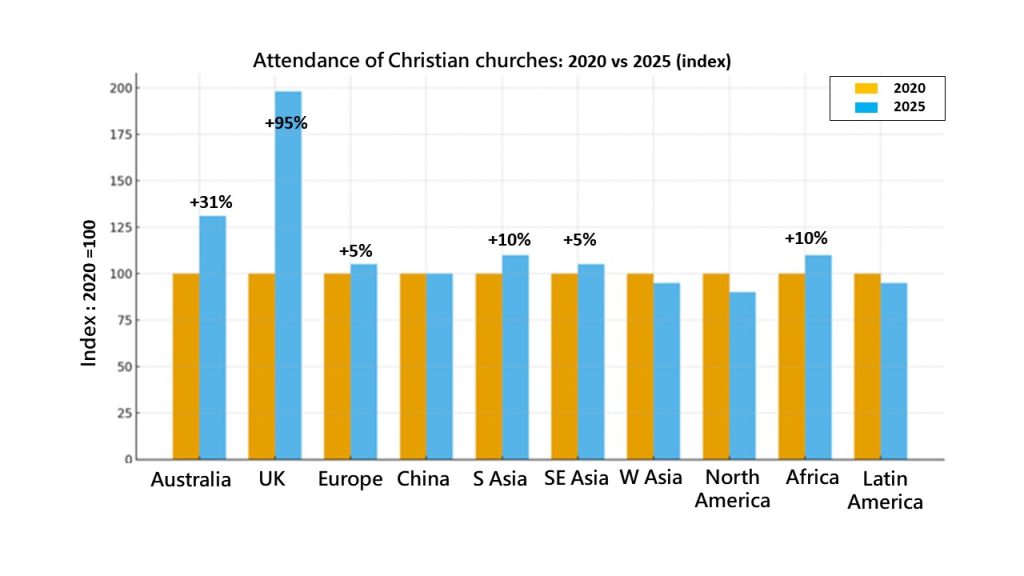
Editor’s Note: Due to the lack of unified global data, the chart above was generated by ChatGPT, drawing on statistics from various research sources for comparative analysis. (NCLS, Bible Society, Pew Research Centre, Philstar News, Afrobarometer Microdata World Bank, Reuters etc.)
Based on various research findings, the global resurgence of Christian faith can be observed in several key trends:
1. The Undercurrent of Secular Youth Seeking Faith
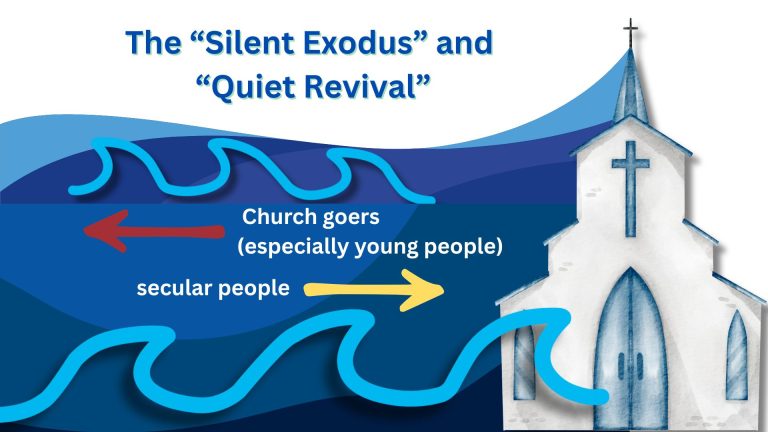
A widespread global phenomenon has emerged: while many young people who grew up in the church are leaving, a growing number of those without any prior religious background are now coming to faith and joining churches.
- Australia: Among young adults aged 18–34, 32% attend church at least once a month. Moreover, 70% of Millennials (born 1981–1996) and Gen Z (born approximately 1995–2010) demonstrate a more serious and personal foundation of faith compared with older generations of Christians (NCLS Social Research, 2021).
For example, in a large youth gathering hosted by the Anglican Church in Sydney’s Northern beaches, out of more than 500 attendees, 100 young people made decisions to follow Christ (Reach Australia, 2025).
- United Kingdom: From 2018 to 2024, the proportion of people attending Christian churches rose from 8% to 12% — a 50% increase.
a) The most significant growth occurred among the 18–24 age group, which jumped from 4% to 16% (Bible Society, “The Quiet Revival,” 2025).
b) These new believers show genuine commitment—about 40% regularly read the Bible and pray.
c) Young people are also increasingly open to faith: 34% of non-believers said they would accept an invitation to attend a church event.
* In contrast, North America continues to see a sharp decline. Weekly church attendance among Gen Z dropped from 22% in 2020 to 16% in 2023 (Edge Club Report). It is estimated that by 2025, at least one-third to one-half of the younger generation will have disengaged from the church.
2. Older Generations Returning to Faith
- In Australia, among those who identified as having “no religion” in the 2016 census, 10% (784,000 people) had embraced Christianity by 2021. Notably, 48% of these new believers were aged 55 and above (McCrindle Social Research, 2025).
- In the United Kingdom, church attendance among those aged 65 and above increased from 14% in 2018 to 19% in 2024.
3. Rapid Growth in Catholic and Charismatic Churches
As people grow weary of secularism and the virtual world, many are turning toward spirituality—seeking either the deep tradition and ritual of the Catholic Church, or the vibrant spiritual experiences found in Charismatic congregations.
- According to The Quiet Revival (Bible Society, 2025), in the UK, attendance in Catholic churches has risen from 23% to 31%, and Charismatic churches from 4% to 10%. Meanwhile, the Church of England, which has adopted increasingly liberal positions in recent years, has seen attendance decline from 41% to 34%, suggesting such approaches may not resonate with people’s spiritual needs.
- Ben Fitzgerald, leader of the “Awakening Europe” movement, reports that while the overall number of Christians in Europe declined by about 5% between 2020 and 2024, revival movements have sparked remarkable growth. Across Germany, France, and Switzerland, an average of 150 people each week are coming to faith through Awakening Europe events. Additionally, church planting continues to expand. In France, the Catholic Church saw a 160% increase in baptisms from 4,000 in 2015 to 10,000 in 2025, with the majority of new believers aged 18–25.
4. Growth of Christianity in Traditionally Non-Christian Nations
- Iran (currently the fastest-growing Christian population in the world): Between 2020 and 2025, the number of Muslim Background Believers (MBBs) in underground churches has grown at an estimated annual rate of 15–19%, potentially reaching 3 million believers today (Open Doors & Elam Ministries).
- South Asia: Based on 2020 growth trends, the region is projected to see an increase of 6 million Christians by 2025 (Gordon-Conwell). In India, for instance, the Christian population has grown from approximately 31 million in 2020 to 34 million in 2025 (Wikipedia).
- Indonesia: In 2020, there were about 30 million Christians, with an annual growth rate of 5% (Badan Pusat Statistik projection), equivalent to roughly 450,000 new believers per year. By 2025, the Christian population is expected to reach 32.25 million.
5. A Growing Trend of Men Returning to Church (Masculine Christianity)
- In the UK, between 2018 and 2024, church attendance among 18–24-year-old men increased from 4% to 21%, a sharper rise than among women. Across all adults, 13% of men attend church monthly, compared to 10% of women (Bible Society, 2025).
- In the United States, the past three years have seen a remarkable gender shift in church attendance. As of 2024, 30% of men attend church weekly compared to 27% of women, marking a reversal of the long-standing trend (Barna State of the Church Report, 2025).
Underlying Causes Behind This Global Faith Resurgence
1. Young People Searching for Meaning in Life
The global pandemic profoundly affected Gen Z. Online learning deprived many of normal social development during adolescence, leading to a significant rise in anxiety and depression.
Growing up in a post-postmodern world, Gen Z faces an overwhelming flood of information online. This has pushed them to think critically, rather than passively accepting atheistic or purely secular ideas. They are a “reflective generation”, deeply hungry for meaning, purpose, and direction in life — many even suffer from what could be called “Meaning/Purpose Hunger.”
This yearning is an innate and powerful spiritual desire — one that can only be satisfied when people discover a true sense of calling and purpose. Having spent much of their lives in virtual spaces, this generation now values relationships and authentic community more than ever. They are seeking deeper spiritual and faith-based answers, and they long for communities that are not merely formal gatherings but places of genuine support and emotional connection.
Moreover, as digital natives, they are accustomed to forming opinions and communities through social media. This also helps explain why young conservative Christian voices, such as the recently assassinated Charlie Kirk, have wielded such powerful influence among their peers.
2. The Crisis of Loneliness
The pandemic plunged the world into an unprecedented sense of isolation. In its aftermath, people continue to face a cocktail of global challenges — economic recession, climate anxiety, skyrocketing housing costs, and intense competition — all of which fuel widespread insecurity and uncertainty about the future.
According to Australia’s State of the Nation Report – Social Connection in Australia (2023):
- 1 in 3 Australians feel lonely.
- 1 in 6 experience severe loneliness.
- Among young adults (18–24), 22% report long-term loneliness; among middle-aged adults (45–54), the figure is 18%.
- Notably, 30% of those who feel lonely do not live alone, and 58% never share their loneliness with anyone.
These individuals are 46% more likely than others to suffer from depression or anxiety.
In contrast, the church, as a faith-based community, provides consistent and meaningful face-to-face connections built on shared values — through counselling, small groups, and caring ministries. This sense of belonging cannot be replicated by AI or social media. The 2024 State of the Bible Report (USA) found that loneliness is one of the main factors driving Gen Z to explore the Bible and Christian faith. In fact, 18% of young respondents said that feelings of loneliness motivated them to engage more with Scripture.

3. Awareness of Life’s Fragility and the Reordering of Values
The pandemic forced people to confront the brevity of life. Many lost loved ones suddenly, leaving them with a deep sense of helplessness and grief — prompting a search for comfort and hope that faith uniquely provides.
Older generations, such as Baby Boomers and Millennials, tended to believe that a stable life could be built through hard work and education — “study well, get a good job, earn a good income.” Success was often measured by material achievement or financial freedom. But Gen Z perceives this differently. To them, both material wealth and career stability feel uncertain, especially after the pandemic. They question the traditional life script of “good university → good job → marriage → children,” recognizing that meaning outweighs material gain. For this generation, the search for a lasting spiritual foundation has become far more compelling than the pursuit of worldly success.
How Should We Respond?
1. Adopt an Open Attitude and Create a Safe Environment for the “Undercurrent” Group
Knowing that most of the “undercurrent” group comes from a secular background, churches must be inclusive and accepting of their differing opinions and values. Emphasis should be placed on creating a sense of “home”—a safe and stable environment where people feel comfortable, relaxed, and loved amid an uncertain world.
Churches should offer faith exploration classes that are discussion-based, allowing participants to open their hearts, share honestly, and discover life purpose and meaning through Christ, even in a world that may seem devoid of hope.
2. Leverage Multimedia to Engage Young People and Encourage Congregants to Invite Friends
Churches need to invest in social media outreach and integrate online and offline efforts to attract young people into community life, then guide them into face-to-face small groups.
Many churches use the slogan “To Know & To Make Him Known”, but the question is: how can today’s generation truly encounter God? How do they even become aware of the church as a community? Take Charlie Kirk as an example. By founding Turning Point USA, he directly entered campuses to engage students in discussion and dialogue. Through multimedia, he has gained a global following: TikTok 73 million; Instagram 7 million; X 5 million; YouTube 3.5 million; podcasts with 1 million listeners per episode. He successfully challenged prevailing secular ideologies on issues like LGBTQ+ rights, abortion, and gender identity, offering young people a clear and compelling Christian worldview. Many university students with no prior religious background are drawn into church because of his influence. Some US campuses have even noted a “Charlie Kirk effect,” with Christian activities seeing 15% higher attendance.
Pastors should encourage and equip congregants to openly share their faith in their families, schools, and workplaces, demonstrating a life of joy and hope grounded in Christ. This naturally attracts those trapped in lethargy, burnout, or purposelessness. Statistics show that 34% of non-believers are willing to accept invitations to church activities—highlighting a prime opportunity for outreach.
3. Emphasize Intergenerational and Multilingual Ministry
Such initiatives can help reduce attrition while also meeting the needs of young people in the “undercurrent” group. Young people don’t just tune out the older generations blindly—they simply reject superficial, preachy, or disconnected teaching. Growing up in an era of information overload, they do not lack knowledge. Unlike older generations who relied on shared experience, young people today need listening, companionship, and relational support.
By organizing intergenerational and multilingual activities, churches can foster understanding across ages and cultures. Congregants, particularly men, can be paired as mentors to guide young men in the undercurrent group, building deep, supportive relationships, helping them connect their faith to life struggles, and encouraging active participation in church ministry—leading them toward a missional life.
4. Strengthen Public Care and Community Service
The undercurrent group, especially young people, often feel a strong sense of social justice and a mission to make the world better. They are deeply concerned with issues such as climate change, racial equality, LGBTQ+ rights, and poverty alleviation.
Churches should not hide away or isolate themselves in a pluralistic society. Jesus Himself demonstrated love in a tangible, incarnational way and commanded us to love our neighbours and make disciples of all nations. Public engagement and service are therefore essential expressions of the gospel.
5. Commit to Faith Formation Within Families
Many parents outsource their children’s faith education to Sunday school teachers, seeing it as not their responsibility or expertise. However, research from Youthworks highlights that consistency between home and church is critical. When family teaching conflicts with church instruction, adolescents are more likely to abandon their faith.
Churches should equip parents to be spiritual mentors, providing age-appropriate resources to nurture faith at home. Consider that children spend an average of 1,500 hours per year with their parents, compared with only 50 hours in Sunday school. Parents who lead by example, modelling faith beyond Sundays, and praying and studying Scripture with their children, play a decisive role in instilling Christian values and forming lifelong spiritual habits.
We thank God that amid the most secularized wave of the “Great Dechurching,” He is raising up a “global undercurrent of faith revival.” May the Lord not only allow us to recognize this gospel opportunity but also empower us to respond, be used by Him, and faithfully carry out the mission He has entrusted to us.