

Catch the Future — Reflections on the 2025
ANZ CCCOWE Summit
Joyce Tang (Literature Executive Officer, Chinese Christian Mission Australia)
Editor’s Note:
The article is translated from Chinese.
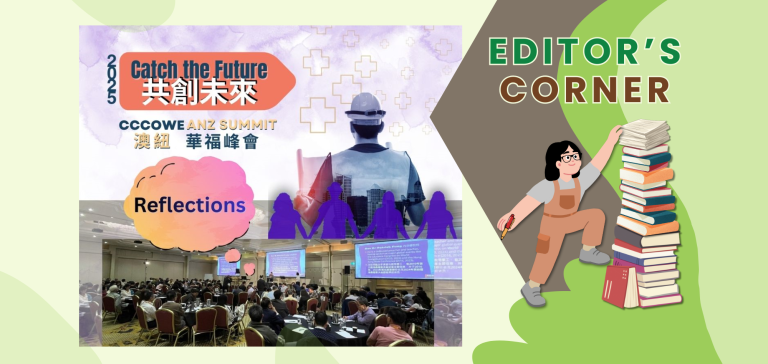
The 2025 ANZ CCCOWE Summit was held in Sydney from 17–20 November with the theme “Catch the Future.” Speakers included Rev. David Doong, Rev. Patrick Fung, and Rev. Sam Chan. A total of 151 participants attended, representing churches, mission organisations, and theological institutions from across Australia and New Zealand.
The Summit has concluded with much gratitude. The speakers offered profound insights and fresh encouragement for thinking about and catching the future “together”. The following is my reflections on the key themes:
1. The Future
Scripture assures us that the Church’s future is filled with hope. Because of Christ, the people of God will ultimately prevail. But this does not mean we can simply be passive.
Although Christ’s Church is certain to triumph, individual believers and local churches may still struggle or fail. The real question is:
Where do we stand in God’s story? Are we faithful to the calling and mission God has entrusted to us?
Looking Back to the past
Rev. David Doong reminded us that throughout “His-story” (God’s story) — from creation to redemption—the gospel of Jesus Christ is the foundation and centre of everything. God has torn down the dividing wall of hostility and formed a unified New Society (Rev. Patrick Fung). Yet the gospel is not simply a starting point; it is a daily journey. We are called to embrace the gospel, live it out in our daily lives, and draw lessons from the early Church as well as from faithful pastors and missionaries who have gone before us.
Living Well in the Present
“What we believe about the future shapes how we live today.”
When you know where you are heading, you make different choices now. E.g. If you’ll be in Hong Kong next week, you’ll not go to “Cha-chaan-teng” (Hong Kong style Café) & order pineapple bun today. Though victory is assured, our journey toward it will have highs and lows.
1) Seeing Our Present Reality Clearly
“In the world you will have tribulation.” (John 16:33a) Suffering is not optional—it is part of God’s sovereign plan.
a. Religious persecution is unavoidable.
It remains widely under-reported. In Sub-Saharan Africa alone, more than 16.2 million Christians—including many from Nigeria—have been displaced by violence and conflict. Millions now live in temporary camps (Open Doors). This doesn’t even include places like North Korea or parts of the Muslim world.
b. We live in a Post-Christendom age.
Christianity is no longer culturally dominant. Minority Christians are often portrayed as oppressors. How can we faithfully navigate an increasingly secular environment?
c. Post-pandemic instability is real.
Rising loneliness, anxiety, insecurity, and youth mental-health crises create new ministry challenges.
d. Chinese churches face internal struggles.
Sectarianism, ethnocentrism, and lack of inter-generational communications hinder mission. Many churches face severe attrition—the “Silent Exodus”—especially among young people.
2) Listening to God’s Voice in Our Times
“But take heart; I have overcome the world.” (John 16:33b)
In an age of uncertainty, God has already overcome and still reigns as King.
a. Hold fast to the fear of God and our identity as “missional disciples.”
Rev. Patrick Fung encouraged us to “take risks” for Christ and surrender all to Him. God seeks not the most capable workers, but the available ones.
Rev. Doong summarised God’s mission for His people:
The Great Mandate – cultivate goodness and beauty in our lives and surroundings.
The Great Commandment – love God and love the neighbours He has placed among us.
The Great Commission – make disciples of all nations & teach them God’s Word.
b. Diaspora mission and contextualised evangelism.
Reaching “all nations” can begin with our neighbours. Australia is one of the most multicultural nations in the world: 31.5% of its population are migrants from over 300 ethnic groups (Australian Bureau of Statistics 2024).
Drawing on Tim Keller, Rev. Sam Chan outlined three steps to contextualisation:
- Enter the cultural storyline and worldview of those you reach.
- Challenge the deficiency & dissonance of that worldview.
- Fulfil with Jesus.
c. God has scattered & gathered Chinese people across the world.
“Wherever there is wealth, you will find Chinese.” Chinese churches exist in every region, each with unique strengths. For example, Malaysian and Singaporean Chinese believers understand both Muslim and Buddhist contexts—an advantage for local mission.
Rev. Doong reminded us: the Holy Spirit has already given us unity; our task is to “make every effort” to maintain it. We must shift from a “Church-centred” to a “Christ-centred”, “Kingdom-centred” mindset.
Rev. Fung added this warning from Dixon E. Hoste:
“Unless we are constantly and faithfully wrestling in the heavenlies against the power of darkness, there is a real danger of us becoming involved in wrestling with our colleagues.”
d. Amid secularisation, the Church must not lose its passion to the gospel.
God is stirring an undercurrent of quiet revival among young people globally, especially post-pandemic, as many secular youths seek truth, goodness, and beauty. Humanly impossible—yet nothing is impossible with God. (For more info, please click & read https://ccma.org.au/en/behold-the-rising-undercurrent-of-a-global-spiritual-revival/)
2. Catch/ Co-create (The theme in Chinese is actually “Co-create the future”)
Creation is God’s work and the End is already determined—His perfect victory. Yet God graciously invites His people to participate in His purposes.
I believe the Church is called not merely to “co-create” the future, but to boldly ‘break through’ into it—overcoming obstacles and stepping into the new horizons God has prepared, together as one body.
A small anecdote illustrates the importance of “co-.”
I was entrusted with designing the conference poster. My initial concept featured a designer holding a blueprint. The committee responded quickly: “Please include the idea of teamwork.” Indeed—how could such an essential concept be missing?
Practising “Co-”
a. Starting with the individual — “repent”, “give the heart to God”, “do God’s Will” (in Chinese 誠意、正心、修身)
Rev. Doong consistently led by example, reminding us to practise repentance. May the Spirit reveal the ways we have sinned against God and others.
Rev. Fung urged us to “give” our hearts to God (Proverbs 23:26) so that He can renew us.
Busyness is not the issue; knowing for whom and for what we are busy is.
b. Within the church — “ordering the household” (in Chinese 齊家)
At a recent seminar in Sydney, Dr. Peter T. Cha introduced the TICI* (Thriving Immigrant Churches Initiative) of Trinity Evangelical Divinity School. He stated 3 approaches that immigrant churches may take:
- First-generation-centred approach – churches marginalise the next generations, leading to youth exodus.
- Independent approach – multi-language congregations share facilities but rarely collaborate.
- Inter-dependent approach – TICI proposes a model of cross-generational, cross-cultural partnership and shared mission.
Since 2022, TICI has provided practical tools, progress tracking etc., helping to reshape the church culture. While the principles are widely understood, the key is that TICI enables local churches to partner with one another, journey together, encourage each other and share the experience along the way.
As Rev. Sam Chan reminds us:
“Give the next generation permission to be excellent, and the freedom to fail.”
* https://hiebertcenter.org/tici/ TICI aims to enable and equip immigrant churches to develop healthy intergenerational and intercultural relationships within immigrant churches so that they might thrive as spiritual and missional communities of faith. They plan to start their ministries in Australia soon.
c. Among churches — “strengthening the wider body of Christ” (in Chinese 治國、平天下)
This Summit has begun connecting pastors and organisation leaders across the states and representatives from New Zealand. But the work continues. As Rev. Doong stressed, we must become bridges—building trust, sharing gifts, and strengthening God’s Kingdom together.
We thank God for this Summit—for the nourishment we received through the speakers, and for the faithful service of the committee and volunteers. May this gathering lead not only to short-lived enthusiasm, but to genuine reflection, repentance, surrender, attentive obedience, and united mission as we “catch/co-create” the future.
Let us encourage one another with Rev. David Doong’s words:
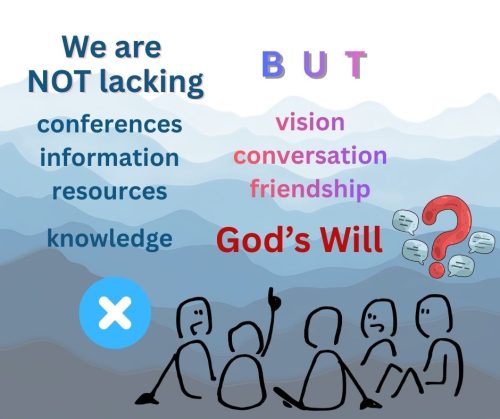
We are not lacking conferences, but vision.
We are not lacking information, but conversation.
We are not lacking resources, but friendship.
We are not lacking knowledge, but God’s Will.